 AI Math Breakthroughs Just Revived Bitcoin Security Fears — But the Practical Threat Is Still Unproven
 Tether Can Freeze Stolen Crypto in Minutes — Getting It Back Can Take Years
 New York Just Secured a $1.37 Billion Court Judgment Against the NovaTech Founders
 The Next ECB Chief Favors Tokenized Bank Deposits Over Stablecoins and Bitcoin
 ESMA Is About to Overhaul the EU’s MiCA Crypto Register in 2027 — Here’s What Changes
 Dogecoin Slips Below $0.058 — The Memecoin Floor Finally Gives Way
 Hyperliquid’s HYPE Finally Slips — Down to $62.73 as the Crash Catches Up
 Uniswap Slips to $4.68 as the DeFi Bounce Fades — UNI Gives Back the Gains

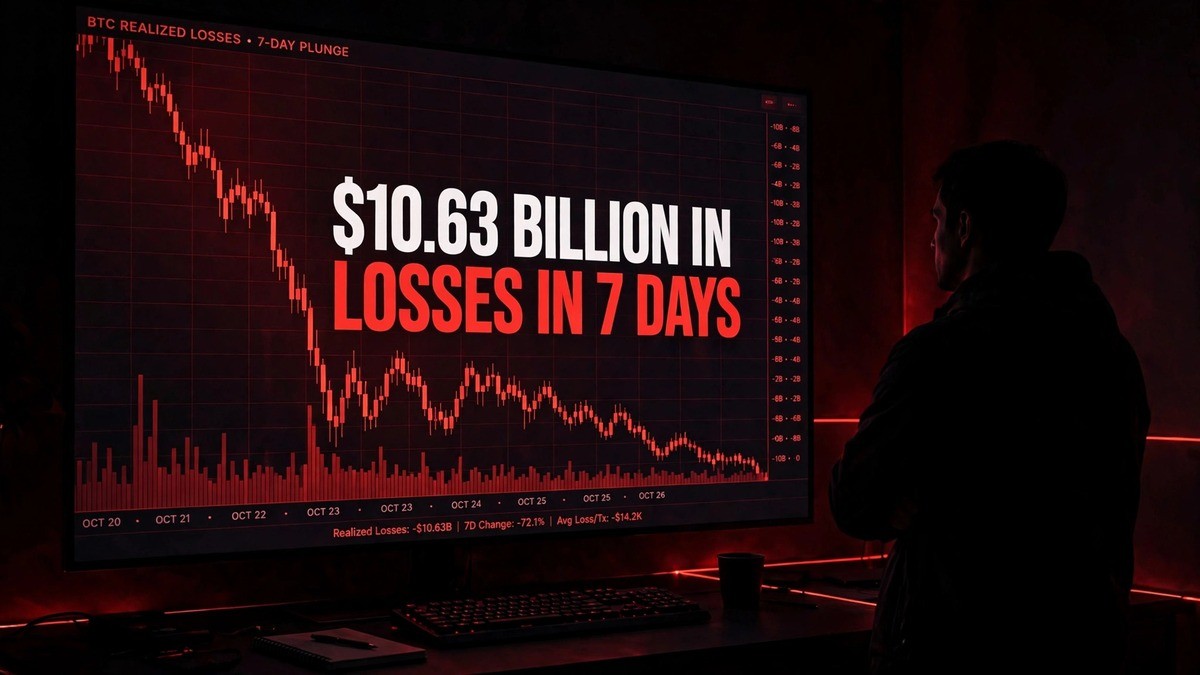
The people who were supposed to never sell are selling — and they are selling at a loss. Long-term Bitcoin holders have realized $10.63 billion in losses over the last 7 days, a pace of loss-taking not seen since February, and the older wallets are the ones leading the selling. If you were looking for a sign of how deep November’s damage goes, this is it.
This is not the usual story of weak hands folding. Long-term holders are, by definition, the wallets that held through the crashes before — the ones who bought years ago and sat through the 2022 bear market without flinching. When those wallets start selling at a loss, it means something has changed. Patience has a limit, and November has found it.
💵 $10.63 billion of losses — a pace not seen since February
The numbers are stark. Realized losses — the losses locked in when coins actually change hands for less than they were bought for — hit $10.63 billion over seven days. Net realized losses, the balance of losses against gains, came in at $8.96 billion. That is a pace of capitulation not seen since February, and it tells you the selling is not a trickle. It is a wave.
What makes it sting is who is doing the selling. On-chain data points to older wallets — the long-term holders — leading the move. These are not the traders who bought the top in October and panicked. These are holders who have been in the market for years, who have seen crashes before and held through them, and who are now deciding that this time is different enough to sell — even at a loss.
It is the kind of selling that only happens when conviction breaks. And conviction breaking among the most patient holders in the market is a signal that deserves attention, whatever the price does next.
📈 SOPR at 0.980 — three weeks below 1
The second number tells the same story from a different angle. Bitcoin’s SOPR — the Spent Output Profit Ratio, which measures whether coins moving on-chain are being sold at a profit or a loss — sits at 0.980. Anything below 1 means coins are, on average, being sold at a loss. And SOPR has now been below 1 for three straight weeks.
Three weeks of selling at a loss is not a blip. It is a regime — a market in which the average seller is losing money on every transaction, and keeps selling anyway. That is what capitulation looks like in the data: not a single dramatic day, but a slow, grinding grind of holders giving up, week after week, until the selling finally exhausts itself.
History says SOPR below 1 for this long usually means the market is close to a bottom — not because the selling is good news, but because selling at a loss cannot go on forever. Sooner or later, the people willing to sell at a loss run out. The question is whether November has reached that point yet, or whether there is more capitulation still to come.
Bitcoin is trading near $61,777 at the time of writing, up about 2.3% over 24 hours, having fought back from $57,300 after the hot PCE print. Ethereum is near $1,734.26. The price has bounced. The on-chain data says the holders have not finished selling yet.
⚠️ Why the old wallets matter most
It is tempting to dismiss holder selling as just another bear-market stat. But the identity of the sellers is what makes this one different. Long-term holders are the backbone of every Bitcoin cycle — the buyers who accumulate in the quiet times and hold through the noise. When they start selling at a loss, it means the market has worn down the very people who were supposed to be unshakeable.
There is a flip side, of course. Every coin sold at a loss is a coin bought by someone else — and the buyers at these levels are getting Bitcoin at prices more than 50% below the October high near $126,000. Capitulation is how bottoms are made: the weak hands sell, the strong hands buy, and the market finds its floor. The $10.63 billion in realized losses is painful for the sellers. For the buyers, it is the transfer of coins from impatient hands to patient ones.
But that transfer takes time. Three weeks of SOPR below 1 says the process is under way, not finished. And with the Fear & Greed Index at 12 — deep in Extreme Fear — the mood is not yet the kind in which sellers stop and buyers rush in.

🎯 What to watch next
Watch SOPR first. A move back above 1 would be the first sign that the average seller is no longer losing money — and that the capitulation phase is ending. Until then, the selling is still the story.
Watch the ETF flows second. US spot Bitcoin ETFs have seen $5.39 billion in net outflows in November, a record month, with seven straight sessions of selling. The institutional exit and the long-term holder exit are the same story told twice — and both have to slow before the market can turn.
And watch $60,000. Bitcoin fought back above it after the PCE drop, and holding it would say the buyers are absorbing the selling. Losing it would say the old wallets still have more to give up — and the bottom is still ahead of us.
The holders who never sell are selling at a loss. That is either the bottom forming — or the warning that it has not formed yet.
#CryptoBulletin #Bitcoin #BTC #BTCPrice #BitcoinPrice #LongTermHolders #HODL #CryptoNews #CryptoMarket #CryptoNewsToday #CryptoMarketToday #TopCryptoStory #SOPR #Ethereum #Altcoins