 Massachusetts Could Ban Every Crypto ATM — Lawmakers Have Until January 5 to Decide
 POTS Money Just Lost $5.71 Million in Minutes — And Its Token Went Straight to Zero
 Strategy Gets Kicked Out of the MSCI Indexes Tomorrow — The $37 Billion Decision Hanging Over Bitcoin
 Binance Just Emptied Its SAFU Bitcoin Wallet — 7,500 BTC Out, $500 Million USDC In
 Cardano’s Big Upgrade Just Slipped to 2027 — And Its DJED Stablecoin Shuts Down on New Year’s Eve
 Dogecoin Price Today, Nov 29: DOGE Stares Down an 8th Straight Losing Week as ETF Flows Stall
 Bitcoin’s Brutal November: Down 24% With 11.1 Million Coins Underwater — Is $59,000 the Floor?
 Tether’s Secret Billionaire Exposed: Russian VC Quietly Holds a Multibillion-Dollar Stake in the $184B Stablecoin Giant
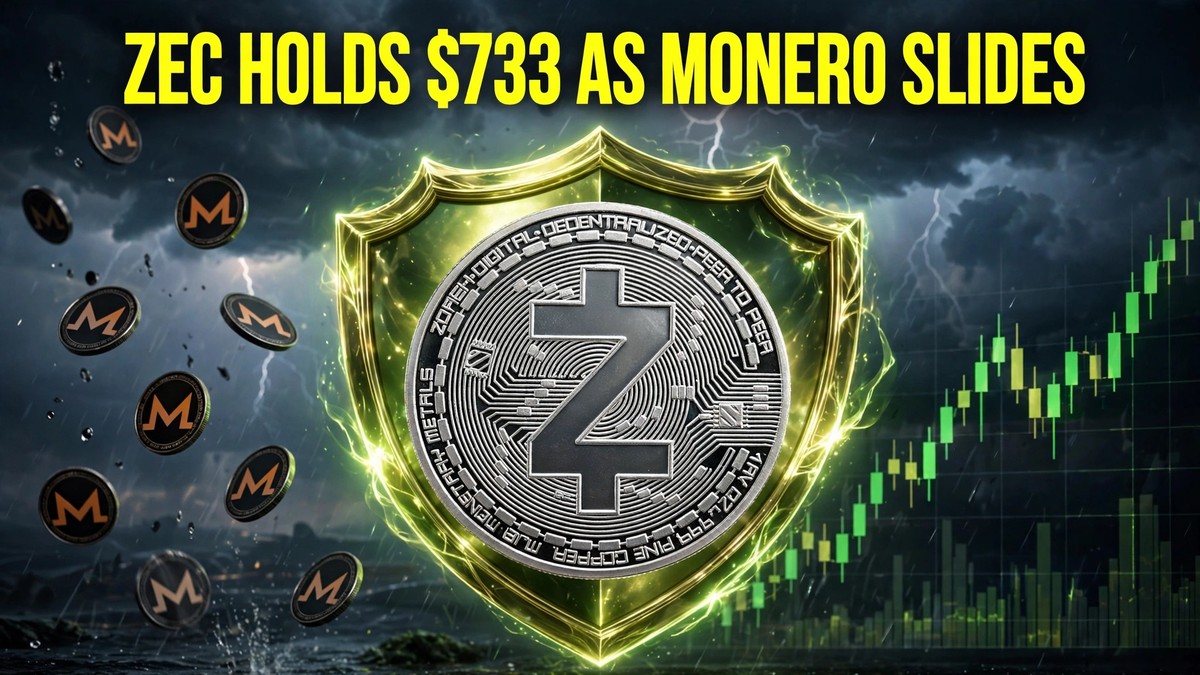
While most of the market stalls, Zcash is still the privacy coin the market is choosing. ZEC surged past $748 overnight, touching $763.13, and has since pulled back to $733.67 — down 2.46% over 24 hours, but still holding well above Monero as the money that used to sit in XMR looks for a new home. One privacy coin is being delisted. The other is being bought — even on a red day.
The contrast could hardly be sharper. On the same day Zcash pushed toward $763, Monero fell another 7.89% as KuCoin’s November 30 delisting deadline closes in. The two coins that used to be mentioned in the same breath are now moving in opposite directions — and the market is voting with its money.
### 💵 From 1.42x to 1.72x — the flip in one number
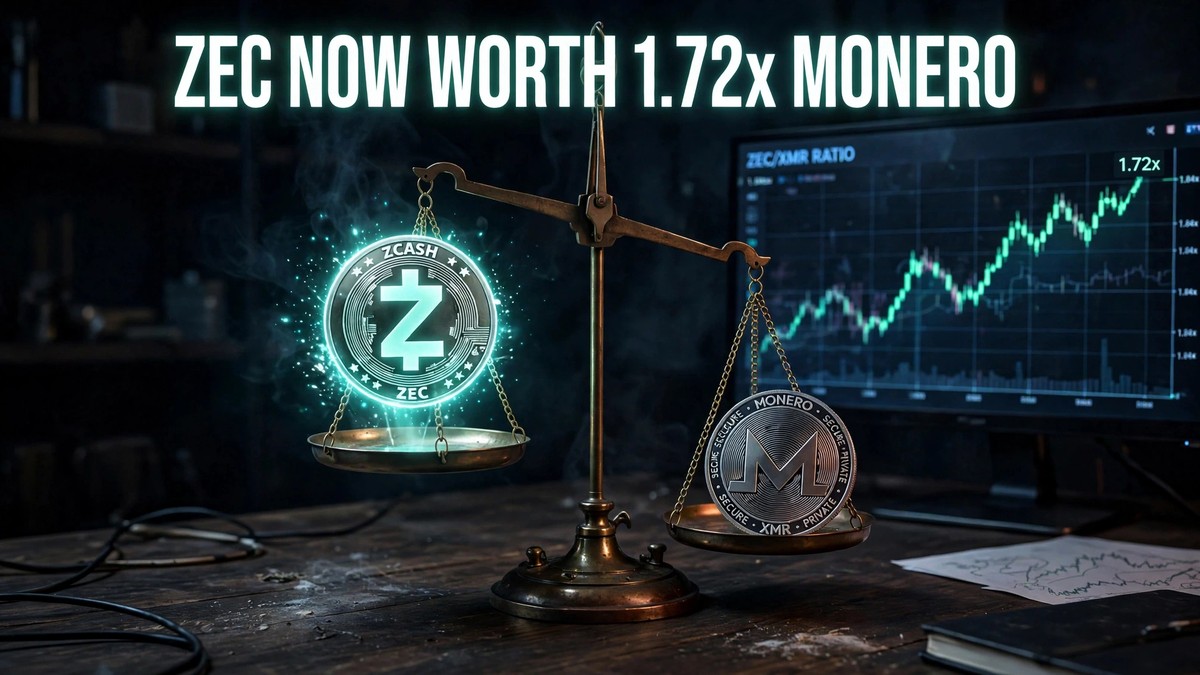
The cleanest way to see what is happening is the ratio between the two coins. Not long ago, one ZEC was worth about 1.42 times one XMR. Now, after Zcash’s surge and Monero’s slide, that ratio stands at roughly 1.72x — up about a fifth in a matter of days. At the peak of the move it touched 1.84x, before ZEC’s pullback trimmed it. Either way, it is a dramatic repricing of two coins that used to trade as peers.
It is worth putting Zcash’s own move in context too. ZEC staged a sharp rebound from support near $690, surging past $748 to a 24-hour high of $763.13, and the pullback to $733.67 comes after a bruising few weeks for the coin — it is still down sharply over the past month, and it remains far below its September high near $1,653. This is not a coin at all-time highs. It is a coin bouncing hard from a low, with a very specific reason behind it.
That reason is the delisting wave. KuCoin is removing all four of its XMR spot pairs on November 30. MEXC already removed its XMR spot trading earlier this month. And with the European Union preparing rules that will bar regulated platforms from handling anonymity-enhancing coins from July 2027, the market is asking a simple question: which privacy coin survives the crackdown — and which one does not?
### 📈 Why Zcash is the one getting the money
The answer the market is giving, at least for now, is Zcash — and there is a real structural reason for it. Monero hides every transaction by default, using ring signatures that obscure the source of a payment among many possible signers. Zcash is different: it lets users choose between transparent transactions and shielded ones, using zero-knowledge proofs to verify a shielded transaction without revealing its details on-chain.
That difference matters enormously to regulators and institutions. A coin that can be transparent when it needs to be is a coin that exchanges and funds can defend. A coin that is private by default, with no off switch, is a much harder sell — and the delistings are the proof. Binance delisted Monero in 2024. Kraken ended support in the European Economic Area later that year. Now KuCoin and MEXC have followed.
Grayscale, which launched the first US spot ZEC exchange-traded fund in August, has been making exactly this argument. Its head of research has said Zcash is positioned differently from Monero and that the firm’s commitment to Zcash will continue for many years. The ETF reached $1 billion in assets under management in September, though that figure has since fallen to around $406 million as prices slid — a reminder that even the winners in this story have taken damage.
### ⚠️ The recovery looks fragile
Here is the honest part. Zcash’s surge is real, but the ground under it is not yet solid. The coin is down 2.46% on the day at $733.67, and the pullback from $763.13 shows how fast a surge can fade. The coin is still down heavily over the past month, and the rebound from $690 support looks sharp precisely because the fall before it was so steep. A surge to $763 is a great day. It is not a trend — not yet.
There is also a risk in reading too much into the Monero money rotation. Some of the money leaving XMR is not rotating into ZEC at all — it is leaving privacy coins entirely, or leaving crypto for the sidelines. The ratio between the two coins can rise because Zcash goes up, or because Monero goes down, or both — and right now it is both. A ratio is not a flow, and nobody should confuse the two.
And the regulatory picture is far from settled for Zcash either. The same European rules that are pushing exchanges to drop Monero will force every privacy coin to prove its case. Zcash’s optional privacy gives it a stronger argument than Monero’s default privacy — but an argument is not a guarantee, and the exchanges that delisted Monero have not promised to keep Zcash forever.

### 🎯 What to watch next
Watch $763 first. That is the 24-hour high Zcash just set, and a break back above it would say the surge has legs. A rejection there would say the rebound was a one-day wonder — and ZEC has had plenty of those in a volatile month.
Watch the ZEC/XMR ratio second. It has already moved from 1.42x to about 1.72x. If it keeps climbing, the market is still choosing Zcash over Monero. If it stalls, the rotation may be running out of money.
And watch November 30. That is the day KuCoin’s delisting takes effect, and the day Monero loses its biggest trading venue. Whatever happens to XMR on that day, Zcash will be watched just as closely — because in a privacy-coin crackdown, the survivor is the story.
Zcash surged past $748, pulled back to $733, and still holds a commanding lead over Monero. The privacy trade has picked its winner — for now.
#CryptoBulletin #Zcash #ZEC #ZECPrice #Monero #XMR #PrivacyCoins #CryptoNews #CryptoMarket #CryptoNewsToday #CryptoMarketToday #Altcoins #KuCoin #Grayscale #Blockchain