 Massachusetts Could Ban Every Crypto ATM — Lawmakers Have Until January 5 to Decide
 POTS Money Just Lost $5.71 Million in Minutes — And Its Token Went Straight to Zero
 Strategy Gets Kicked Out of the MSCI Indexes Tomorrow — The $37 Billion Decision Hanging Over Bitcoin
 Binance Just Emptied Its SAFU Bitcoin Wallet — 7,500 BTC Out, $500 Million USDC In
 Cardano’s Big Upgrade Just Slipped to 2027 — And Its DJED Stablecoin Shuts Down on New Year’s Eve
 Dogecoin Price Today, Nov 29: DOGE Stares Down an 8th Straight Losing Week as ETF Flows Stall
 Bitcoin’s Brutal November: Down 24% With 11.1 Million Coins Underwater — Is $59,000 the Floor?
 Tether’s Secret Billionaire Exposed: Russian VC Quietly Holds a Multibillion-Dollar Stake in the $184B Stablecoin Giant
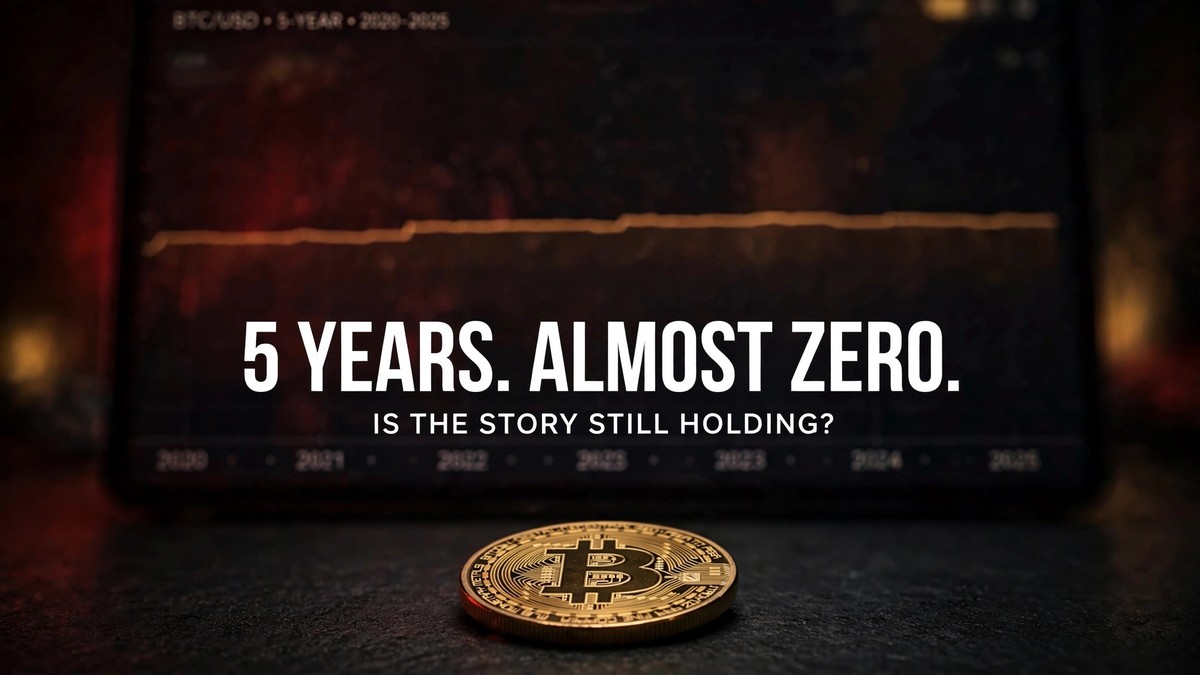
Here is a number that should stop every Bitcoin holder in their tracks. A dollar put into Bitcoin on November 18, 2021 is worth about $1.10 today. Five years, one halving, a spot ETF boom, a pro-crypto president — and the return, before inflation, is less than 10%. That is the starting point of a CoinDesk opinion piece published on November 23 by Omkar Godbole, one of the publication’s most experienced markets writers, and it is the most uncomfortable question Bitcoin has faced in years: what if the great stories that powered its rise have already been told?
This is an opinion, not a fact — and it needs to be read that way. Godbole is not saying Bitcoin is finished. He is saying the maths of its past no longer supports the dreams of its future, and that what is left driving the price is something far more ordinary: the US Federal Reserve. Here is his case, and the case against it.
💵 $1.10 on the dollar — five years, less than 10%
The numbers are simple and, for that reason, hard to argue with. Bitcoin traded around $61,500 when Godbole wrote the piece, against roughly $58,600 five years earlier. That is a gain of under 10% over five years, before inflation — which means, in real terms, a loss. The rolling five-year return actually turned negative a couple of days before publication, dipping to a low of -2.2% on November 14, 2026. It has happened only twice before: in December 2022, when the low was -14.4%, and briefly in January 2023. Out of 4,343 daily readings since October 2014, the five-year return has been below zero on just 8 days — and one of them was this month.
The last time it went negative, in December 2022, Bitcoin was trading near $16,000. What followed was a rally to more than $126,000, in line with the halving cycle. That is the first counter-argument to Godbole’s gloom, and he makes it himself: the last time the five-year return went to zero, it marked something close to a bottom, not the end. But his point is about what came after the rally, not the rally itself.
Because the rally ended at a record high of more than $126,000 on October 6 — and Bitcoin is now about 49% below that peak, trading near $59,277 at the time of writing, down about 0.80% over 24 hours. The five-year return has recovered to about +4.9% as of November 23, but only because the comparison point keeps moving. The gain, such as it is, is barely there.
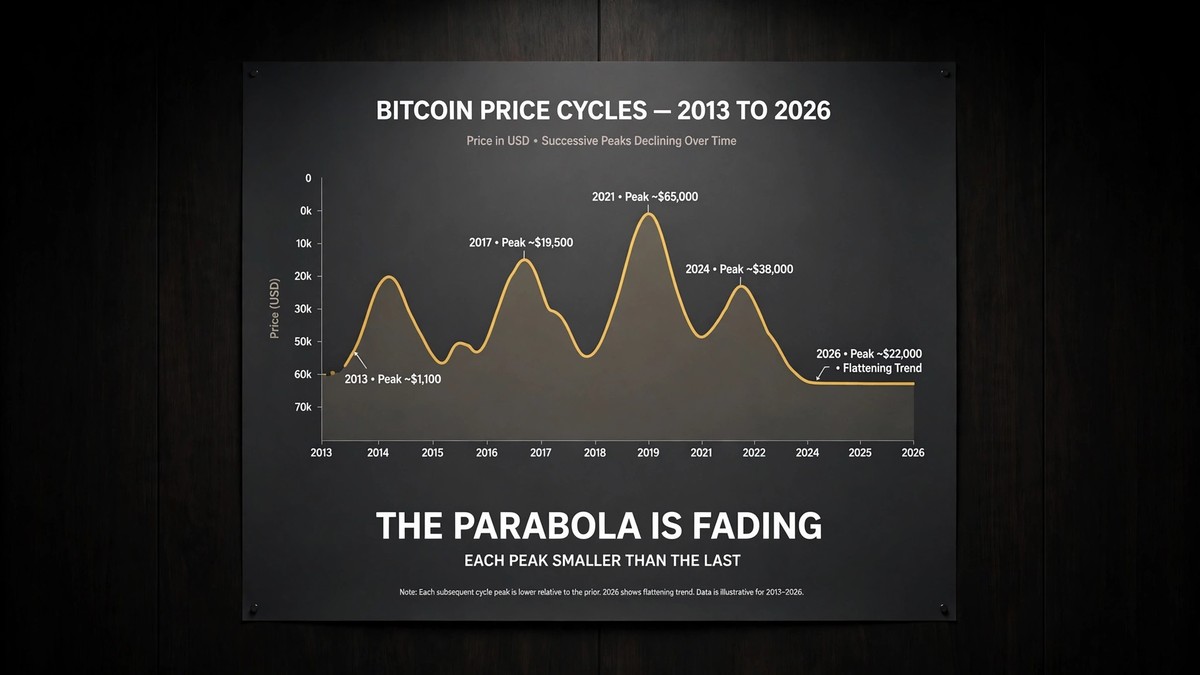
📈 Each peak smaller than the last — the shrinking parabola
Godbole’s core argument is about the shape of Bitcoin’s cycles. Every cycle has peaked at a smaller multiple of the one before it. The 2013 peak was about 42 times the 2011 peak. The 2017 peak was about 16 times the 2013 peak. The 2021 peak was about 3.5 times the 2017 peak. And the 2025 peak was just 1.8 times the 2021 peak. The parabola, in his words, has weakened significantly. Each bull run lifts Bitcoin less, relative to where it started, than the one before.
The narratives, he argues, have been spent one by one. Digital gold was the pitch for years. Then came the halving cycle, then institutional adoption, then the spot ETFs, then a pro-crypto president — and at the height of the bull market early last year, social media posts were seriously suggesting the US government could buy loads of Bitcoin, sell it a few years later, and use the profit to write off its debt. That belief, Godbole writes, was an example of how past performance shaped expectations. The stories got bigger as the returns got smaller.
And there is a sting in the volatility numbers. Bitcoin’s 90-day annualised volatility stood at 39% when he wrote, against just 5% for the euro-dollar pair, the world’s most traded currency. Bitcoin is still swinging like a speculative asset while returning, over five years, almost nothing. That combination — high volatility, low long-term return — is the heart of his challenge to the “digital gold” pitch.
⚠️ What is left is the Fed — and that is the real argument
If the great narratives are fading, what is left? Godbole’s answer is blunt: the Fed. Most analysts CoinDesk spoke to recently pointed to Fed rates as the main thing that matters for Bitcoin now. After more than 17 years of meteoric price gains, the arrival of spot ETFs and a pro-crypto president, Bitcoin’s fate still appears tied to what the central bank does. His conclusion is that Bitcoin’s primary role may be evolving into a 24/7 VIX — a blockchain-based counterpart to Wall Street’s fear index, rising and falling with liquidity rather than with any story of its own.
That is a provocative claim, and it is worth stating plainly that it is one veteran’s interpretation, not a consensus. The counter-case is strong: the last time the five-year return went negative, Bitcoin went on to gain roughly eightfold. The halving cycle has not been broken, only stretched. And the flows tell a mixed story — November’s record $5.78 billion in ETF outflows is real, but the ETFs exist at all, and the Fear & Greed Index at 10, deep in Extreme Fear, has marked buying opportunities before.
Godbole himself leaves the door open. Bitcoin will almost certainly have another bull run, he writes — but that run could be less bullish than past ones, and negative rolling five-year returns could become more common. It is a warning about the size of the next run, not a claim that there will not be one.
🎯 What to watch next
Watch the Federal Reserve first. The next FOMC meeting is December 9-10, and Godbole’s whole argument rests on the idea that rates, not narratives, now decide Bitcoin’s direction. A dovish signal there would be the first real test of his thesis — if Bitcoin rallies hard on it, the “24/7 VIX” label starts to look accurate. If it does not, the story is more complicated than rates alone.
Watch the five-year return itself second. It sits near +4.9%, a hair above zero. If Bitcoin slips much further, it goes negative again — only the ninth day in more than a decade. If it recovers, the uncomfortable number quietly disappears from the conversation. Either way, the chart will be watched.
And watch whether the next bull run, when it comes, breaks the pattern. A peak much higher than 1.8 times the last one would answer Godbole’s argument directly. A peak that fits the shrinking pattern would confirm it. The answer is years away — but the question, for the first time, is being asked out loud by one of crypto’s own veterans.
Five years. A dollar became $1.10. The stories are fading — and the Fed is what’s left.
#CryptoBulletin #Bitcoin #BTC #BTCPrice #CryptoNews #CryptoMarket #CryptoNewsToday #CryptoMarketToday #TopCryptoStory #BitcoinPrice #Ethereum #Altcoins #CryptoTrading #FederalReserve #CoinDesk