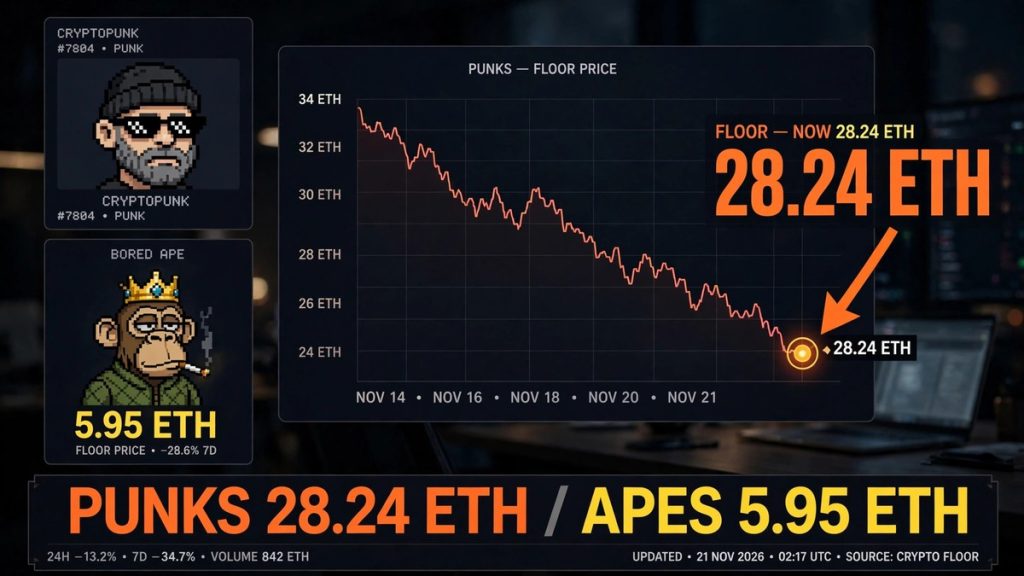
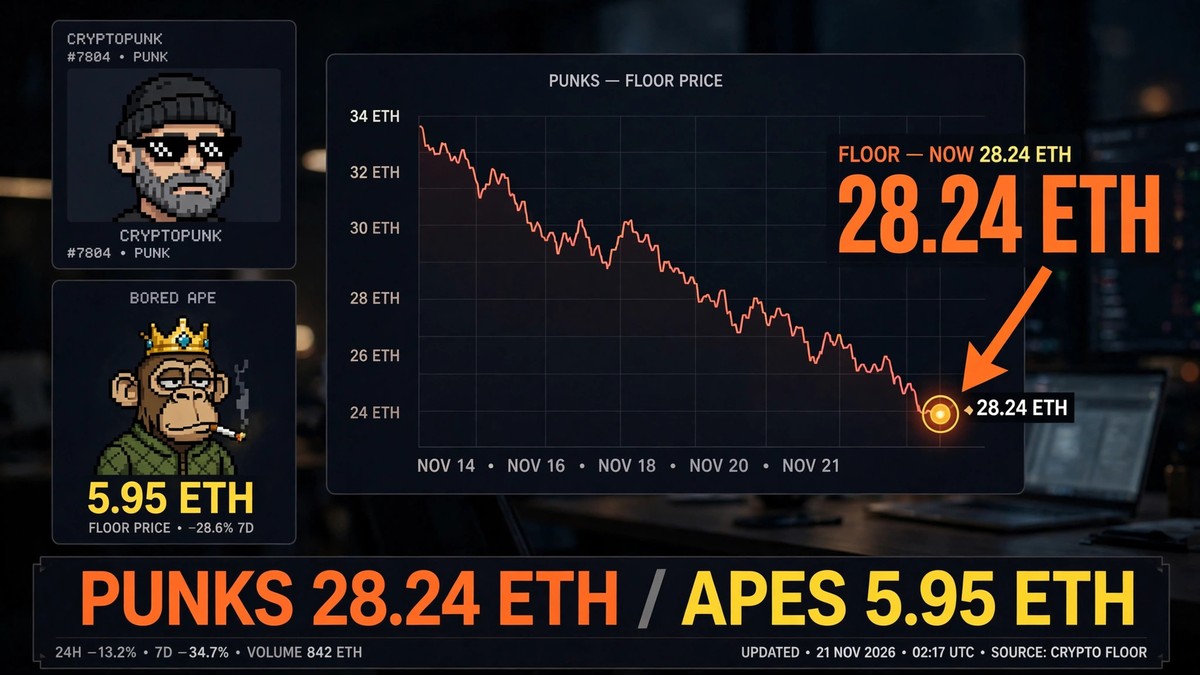
 CryptoPunks Floor Slips to 28.24 ETH as Bored Apes Fall to 5.95 ETH
 Blue-Chip NFTs Rise While Crypto Falls — Lil Pudgys and Azuki Lead as Azuki Cards Hit Stores
 MoneyGram Lets Solflare Users Cash Out Solana USDC in 170+ Markets
 Solana Falls Below $70 After Mainnet 1.0 as Roundhill Drops Its Solana ETF Plan
 Ripple’s RLUSD Hits Record $2.7B as Binance Offers 600,000 XRP Airdrop to Holders
 Russia Opens Bitcoin, Ethereum and USDT Trading to Retail Investors Under New Rules
 Bitcoin ETFs Lose Over $3.5B in November as BlackRock’s Record $541M Exit Leaves Q3 Buyers 19% Underwater
 Crypto Market Today, Nov 22: Bitcoin Below $56,000, Ethereum Near $1,630 as Fear Stays Extreme

Stablecoins do not shout. They whisper. And right now, that whisper is worth listening to.
Total stablecoin supply stood at $286.4 billion on 17 November, down from $302.5 billion a month earlier, according to DefiLlama figures reported via VoxTradePro. That is a fall of about $16.1 billion in a month, or roughly 5%. In a market that talks about Bitcoin and Ethereum all day, a 5% drop in stablecoins can pass unnoticed. It should not. Stablecoin supply is one of the quietest tells in crypto, and it is telling a cautious story.
What is a stablecoin, in plain words? It is a crypto token designed to stay near one dollar. USDT, or Tether, is the best-known one. People hold stablecoins when they want to stay in crypto without holding a coin that can swing 10% in a day. They hold them as dry powder — money parked on the sidelines, ready to buy. They hold them to move money between exchanges, to earn yield, or to step out of a volatile coin without leaving crypto altogether.
That is why supply matters. When stablecoin supply grows, it often means fresh dollars are coming into crypto. Someone bought USDT or another stablecoin with real money, and that money is now sitting inside the system, ready to be used. When supply shrinks, it often means the opposite. Dollars are leaving. People are cashing stablecoins back into bank money, or they are using them and not replacing them. A $16.1 billion fall in a month is a lot of dollars stepping back.

The snapshot for these drafts fits that cautious picture. On 19 November at about 09:43 UTC, Bitcoin was at $63,902, down 1.2% on the day, about 50% below its $126,080 peak from October 2025. Fear and Greed read 10, Extreme Fear. Bitcoin ETFs lost $306.4 million on 18 November, with no inflow at all. Ether ETFs lost $39.8 million. Total market value sat near $2.24 trillion. None of those numbers on their own tells the whole story. Together, they describe a market where money is careful.
Stablecoins sit at the centre of that careful mood. If traders were rushing to buy the dip, you would expect stablecoin supply to be rising, or at least holding steady, as fresh money arrived to buy Bitcoin and Ethereum at lower prices. A fall to $286.4 billion from $302.5 billion points the other way. It points to money leaving, or at least not arriving in the same size as before. That does not prove a crash is coming. It proves the fuel tank is a little emptier than it was a month ago.
USDT is the focus here for a simple reason. It is the largest stablecoin and the one most traders touch first. When people talk about stablecoin supply, USDT is the biggest part of that number. Watching USDT is like watching the biggest pipe in the system. If the biggest pipe is carrying less, the whole system has less to work with. That is true even if you never hold USDT yourself. Its flows affect liquidity across exchanges, across DeFi, and across the coins you do hold.
There is a related story to keep separate. A 19 November article on stablecoins leaving — about $1.46 billion out in a week — is a different article from this one. This draft does not repeat its figures as its own. It only notes it as context, so readers do not confuse the two stories. The verified figures in this article are the DefiLlama totals: $286.4 billion on 17 November versus $302.5 billion a month earlier, down about 5% in a month. Keeping those stories apart matters, because mixing weekly and monthly numbers is how confusion starts.

Why call stablecoins a “quiet tell”? Because they do not move like Bitcoin. Bitcoin can jump or fall on a headline in minutes. Stablecoins move slowly, in the background, as people make real decisions about cash. A trader who sells Bitcoin for USDT is still in crypto. A trader who sells USDT for dollars has left. Supply captures that second step. It is slower, quieter, and often more honest about where money is actually going.
That does not make stablecoin supply a crystal ball. Supply can fall for reasons that have nothing to do with fear. People might move money for tax, for bills, for a better yield elsewhere, or because an exchange changed how it holds funds. A single month of data is a snapshot, not a trend. A 5% fall is notable, but it is not a collapse. Stablecoin supply at $286.4 billion is still huge. There is still a lot of dry powder in the system.
The right way to read it is as a question, not an answer. If supply keeps falling, what does that say about appetite to buy? If supply steadies or starts to rise again, what does that say about money coming back? Those are the questions to carry into the next few weeks. USDT and the wider stablecoin market will answer them quietly, in the background, while Bitcoin takes the headlines.

For now, the tell is simple. Stablecoins are down about 5% in a month. In a market already in Extreme Fear, with ETF money flowing out, that quiet fall is one more sign that caution, not eagerness, is setting the tone.
Disclaimer: This article is for information only and is not financial advice. Do your own research before making any investment decision.
#CryptoBulletin #USDT #Tether #Stablecoins #CryptoMarketToday #CryptoNewsToday #Blockchain #Web3 #CryptoNews #Altcoins #Crypto #BitcoinPrice #MarketUpdate #CryptoCommunity #Investing #Finance