 Massachusetts Could Ban Every Crypto ATM — Lawmakers Have Until January 5 to Decide
 POTS Money Just Lost $5.71 Million in Minutes — And Its Token Went Straight to Zero
 Strategy Gets Kicked Out of the MSCI Indexes Tomorrow — The $37 Billion Decision Hanging Over Bitcoin
 Binance Just Emptied Its SAFU Bitcoin Wallet — 7,500 BTC Out, $500 Million USDC In
 Cardano’s Big Upgrade Just Slipped to 2027 — And Its DJED Stablecoin Shuts Down on New Year’s Eve
 Dogecoin Price Today, Nov 29: DOGE Stares Down an 8th Straight Losing Week as ETF Flows Stall
 Bitcoin’s Brutal November: Down 24% With 11.1 Million Coins Underwater — Is $59,000 the Floor?
 Tether’s Secret Billionaire Exposed: Russian VC Quietly Holds a Multibillion-Dollar Stake in the $184B Stablecoin Giant
Russia’s biggest stock exchange is about to become a crypto exchange. The Moscow Exchange (MOEX) plans to launch organised trading in Bitcoin, Ether and Tether’s USDT on December 1, 2026 — two days from now — opening regulated crypto trading to both qualified and non-professional investors through the brokerage accounts and apps they already use. It is one of the most significant steps any major national exchange has taken toward crypto, and it comes with a tax row that has already thrown the launch into confusion.
The plan itself is straightforward. The complication is what it costs. And with two days to go, one of the biggest questions — whether USDT trades carry a 22% value-added tax — still does not have a final answer.
💵 December 1: BTC, ETH and USDT on the stock market’s own rails
The Moscow Exchange is not building a separate crypto venue. It is routing digital asset trades through its existing stock-market infrastructure, clearing through the National Clearing Centre while licensed digital depositories record ownership. Investors will trade through brokerage accounts and apps they already use rather than personal crypto wallets. Trading hours will mirror the stock market, running from 06:50 to 23:50 Moscow time, with same-day or next-day settlement and swap functionality for liquidity management.
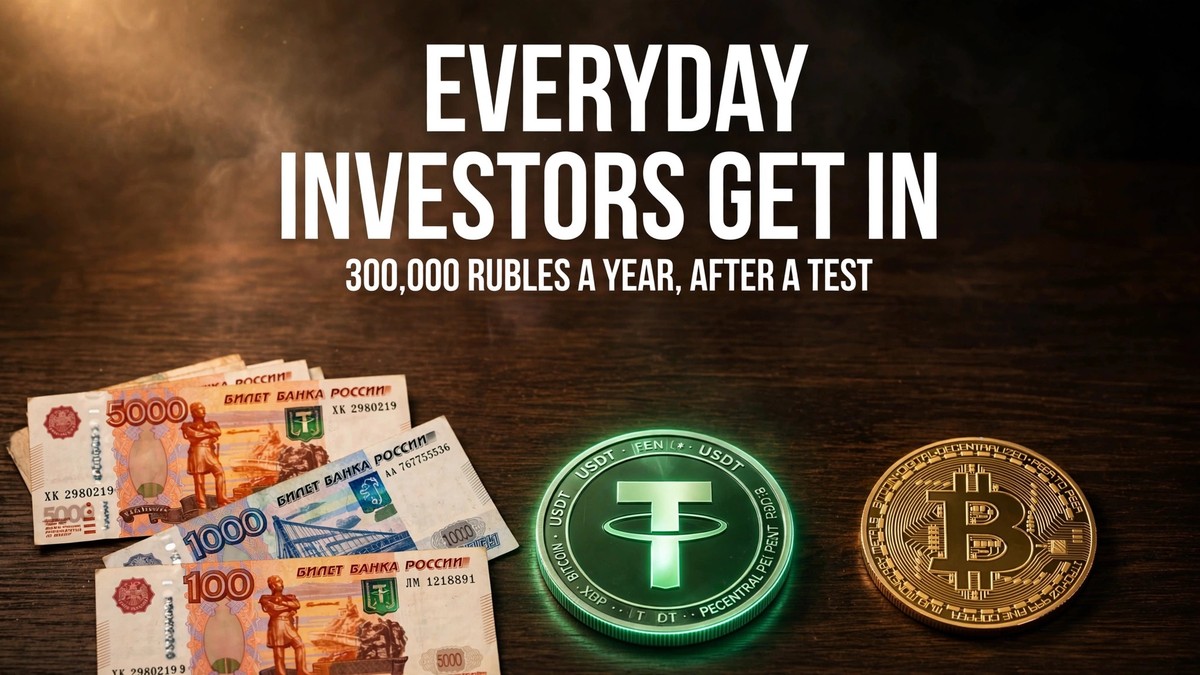
Access will be open to both qualified and non-professional investors, but with conditions. Non-professional investors will face mandatory testing before they can trade, and an annual investment limit of 300,000 rubles — roughly $3,650 — through a single intermediary. The framework sits under Federal Law No. 282-FZ, whose main provisions took effect September 1, 2026, combined with a Bank of Russia directive permitting organised digital asset trading from November 22. Separate Bank of Russia rules taking effect November 17 let non-qualified investors buy Bitcoin, Ether and USDT through licensed intermediaries.
The Moscow Exchange is not alone. SPB Exchange said it will open spot trading in Bitcoin, Ether and USDT against the ruble on December 1 as well, after the central bank added it to the registry of digital depositories on November 27, 2026. Its trading will run from 9 a.m. to 4 p.m. Moscow time, with same-day settlement in rubles, open to qualified and non-qualified investors after testing. Two of Russia’s exchanges, opening crypto trading on the same day, against the ruble.
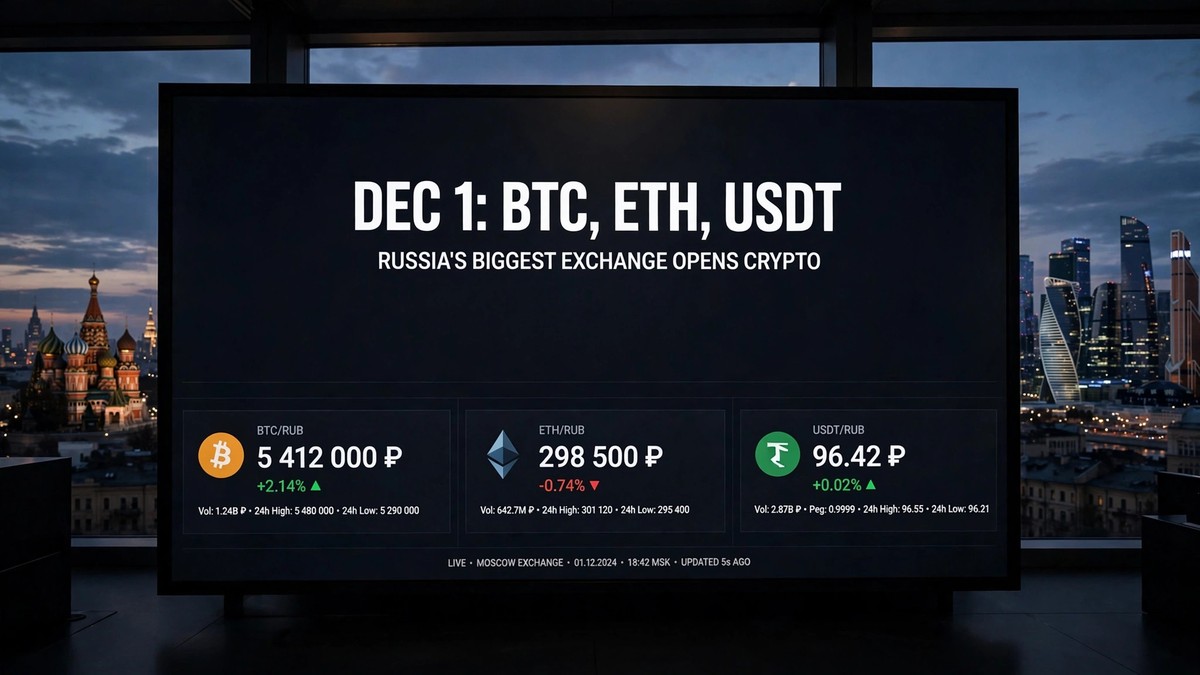
📈 The USDT problem: a 22% VAT that may or may not exist
Here is where the launch gets messy. The exchange’s clearinghouse, the National Clearing Centre, has said that USDT purchases will carry a 22% value-added tax that Bitcoin and Ether trades will not. The NCC said the VAT will apply to USDT purchases, sales and swaps made between December 1 and December 31, added on top of the trade price. A buyer seeking 100,000 rubles worth of USDT would pay an extra 22,000 rubles in VAT, bringing the total cost to 122,000 rubles before broker fees. Legal entities earning profits from such trades would also face a 25% income tax, according to reports.
The reason is how Russian law categorises the assets. Bitcoin and Ether are classified as digital currencies, a category the tax code exempts from VAT. USDT instead falls under a separate designation known as a foreign digital instrument, because it has an issuer — Tether — unlike Bitcoin and Ethereum, which are considered issuerless assets under Russian legislation. As a result, USDT transactions do not currently qualify for the VAT exemption. The clearinghouse is basing the charge on Articles 153 and 164 of the tax code.
And then the story twisted. MOEX later removed its announcement regarding the VAT charge, adding uncertainty to the tax treatment of the stablecoin. The NCC has asked the Federal Tax Service and the Finance Ministry for formal guidance, and its notice currently covers only the month of December. Because the clearinghouse has flagged the tax treatment as provisional and tied to pending guidance from Russian tax authorities, the rules could shift once officials respond — or once lawmakers act on exemptions for trades completed before 2027. Anyone planning to trade USDT on December 1 should treat the 22% figure as unconfirmed, not settled.
⚠️ What this is — and what it is not
It is worth stating plainly what the Moscow Exchange launch does and does not mean. It is a regulated, domestic, ruble-settled market for three crypto assets, built for Russian investors inside Russia’s own financial system. It is not Russia adopting Bitcoin as legal tender, and it is not an open door to the global crypto market. The 300,000-ruble annual cap for non-qualified investors is small — roughly $3,650 a year — and the mandatory testing is a real barrier. The volumes, at least at first, are likely to be modest next to the global market, where Bitcoin alone trades near $59,277 and the Fear & Greed Index sits at 10, deep in Extreme Fear.
But the symbolism is hard to dismiss. A major national exchange — the largest bourse in Russia — listing Bitcoin, Ether and USDT on its own rails, clearing through its own clearinghouse, settling in rubles, is a step no G20 exchange has taken at this scale. It also comes as Russia continues to build parallel financial infrastructure, and as other countries watch closely. Whether the experiment works will be judged not by the announcement, but by the volumes, the tax treatment, and whether the December 1 date actually holds.
🎯 What to watch next
Watch December 1 itself first. Plans and launches are different things, and the VAT confusion is exactly the kind of issue that can delay an opening. If trading opens on schedule, the launch is real. If it slips, the tax row will be the reason — and the first question will be whether the delay is days or months.
Watch the VAT answer second. The NCC’s notice covers only December, and the Federal Tax Service and Finance Ministry have been asked for formal guidance. A 22% charge on USDT would make the stablecoin dramatically more expensive to trade than Bitcoin or Ether on the same venue — and would likely push USDT volume elsewhere. An exemption would remove the biggest cloud over the launch.
And watch the volumes. A 300,000-ruble cap and mandatory testing will keep retail participation small at first. The real test is whether qualified investors and institutions show up — and whether a second exchange, SPB, opening the same day, creates genuine competition or just splits a small market in two. Moscow opens its crypto doors on Tuesday. The world will be watching what walks through them.
Moscow Exchange will list Bitcoin, Ethereum and USDT from December 1. Two days to go — and the tax bill is still undecided.
#CryptoBulletin #Bitcoin #BTC #Ethereum #USDT #Tether #MoscowExchange #CryptoNews #CryptoMarket #CryptoNewsToday #CryptoMarketToday #TopCryptoStory #Russia #BitcoinPrice #CryptoTrading