 Massachusetts Could Ban Every Crypto ATM — Lawmakers Have Until January 5 to Decide
 POTS Money Just Lost $5.71 Million in Minutes — And Its Token Went Straight to Zero
 Strategy Gets Kicked Out of the MSCI Indexes Tomorrow — The $37 Billion Decision Hanging Over Bitcoin
 Binance Just Emptied Its SAFU Bitcoin Wallet — 7,500 BTC Out, $500 Million USDC In
 Cardano’s Big Upgrade Just Slipped to 2027 — And Its DJED Stablecoin Shuts Down on New Year’s Eve
 Dogecoin Price Today, Nov 29: DOGE Stares Down an 8th Straight Losing Week as ETF Flows Stall
 Bitcoin’s Brutal November: Down 24% With 11.1 Million Coins Underwater — Is $59,000 the Floor?
 Tether’s Secret Billionaire Exposed: Russian VC Quietly Holds a Multibillion-Dollar Stake in the $184B Stablecoin Giant
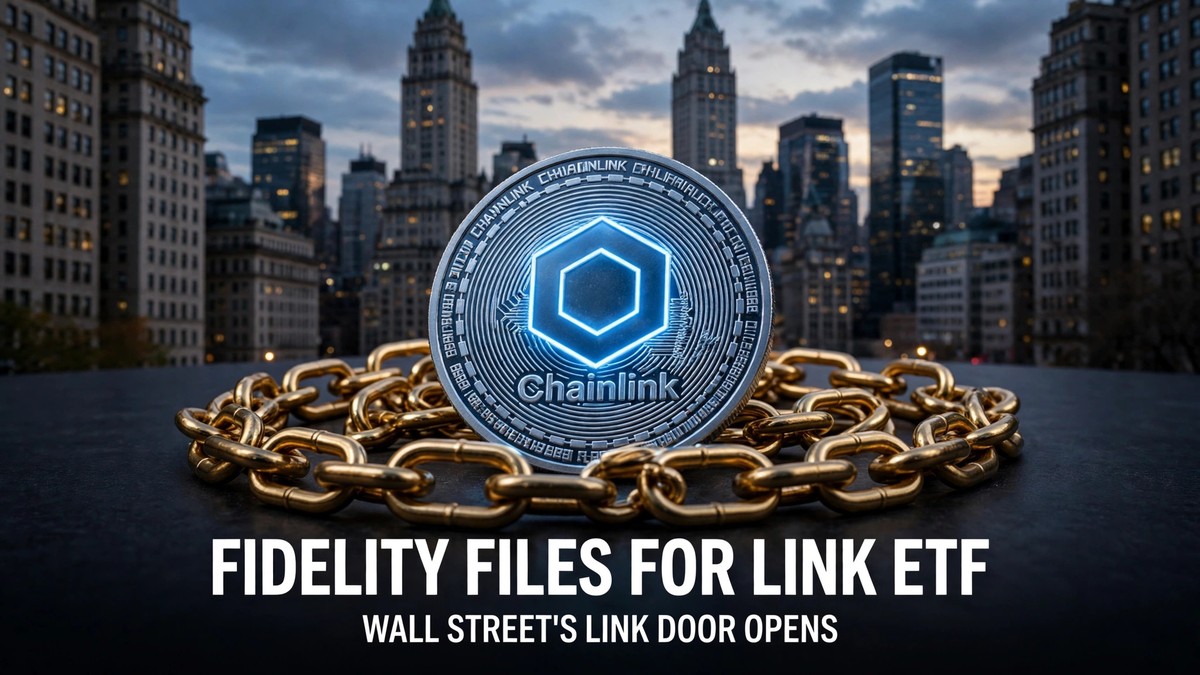
One of the biggest names in American finance has just knocked on Chainlink’s door. Fidelity filed a registration statement with the US Securities and Exchange Commission on Wednesday, November 25, for the Fidelity Chainlink Fund — a spot ETF that would hold LINK directly and trade on Nasdaq under the ticker FLNK. It is the latest step in the steady march of altcoins into Wall Street’s product shelf, and it lands at a moment when LINK itself is trading near multi-month lows.
Before anyone gets carried away, the sentence that matters most: a filing is not an approval. The registration must become effective before the fund can sell a single share, the fee is blank, the ticker is provisional, and there is no launch date. But Fidelity does not file paperwork like this casually — and the filing tells us a great deal about how the world’s largest asset managers now see Chainlink.
💵 FLNK: LINK held directly, no staking, three custodians
The structure is straightforward. The proposed fund would hold LINK directly — not futures, not a basket of blockchain stocks, not a derivative designed to mimic the price — and seek to track the performance of LINK measured by a Fidelity Chainlink Reference Rate calculated by Coin Metrics, less the fund’s expenses and liabilities. The sponsor is FD Funds Management LLC, a wholly owned subsidiary of Fidelity parent FMR LLC. The trust itself was formed in Delaware on November 19, a week before the filing.
Three custodians are named to hold the tokens: Anchorage Digital Bank, BitGo Bank & Trust and Coinbase Custody Trust Company. The trust would hold its LINK only on the Ethereum blockchain, and authorised participants — the trading firms that create and redeem fund shares — would tentatively work in blocks of 25,000 shares. The proposed ticker, FLNK, appears in brackets in the filing, marking it as not yet final. The annual sponsor fee is blank. There is no confirmed launch date.
One detail is spelled out explicitly, and it will matter to LINK holders: the fund will not stake its LINK. “The Trust will not stake its LINK, and Shareholders will not receive staking rewards through the Trust,” the prospectus says. Investors would get price exposure to LINK and nothing else — no yield, no staking rewards, no participation in the network’s oracle economics. Chainlink staking, where holders lock up LINK to help secure the network’s oracle services, is capped at roughly 4% of total supply, the filing notes.

📈 Fidelity is not first — and that is the point
Fidelity would not be the first to market. Grayscale’s Chainlink trust began trading as an ETF on NYSE Arca on December 2, 2025, under the ticker GLNK, and held about $112 million in assets under management as of November 24. Bitwise’s Chainlink ETF, trading as CLNK, registered its shares for NYSE Arca in January 2026 and held about $42 million. Fidelity’s fund would differ in where it trades — Nasdaq rather than NYSE Arca — and in who holds its tokens: three custodians rather than one.
That is precisely why the filing matters. Grayscale and Bitwise proved there is a market. Fidelity’s arrival would prove there is a big one. The two existing funds charge about 0.35% a year; Fidelity’s fee is blank, and the industry will be watching whether the world’s third-largest asset manager undercuts them. The filing also landed one day after Fidelity added LINK — along with Aave and Uniswap — to its retail crypto platform, giving customers two routes to the same token: direct trading through Fidelity Crypto, or exchange-traded shares if the fund becomes effective.
LINK itself, meanwhile, is having a rough month. At the time of writing it trades near $9.03, down about 3.18% over 24 hours, in line with a broad market slide that has Bitcoin near $59,277 and Ethereum near $1,643.22. The filing did not lift the price — filings rarely do. What it did was put a floor under the story: whatever LINK does in the short term, Wall Street’s biggest names are now building products around it.
⚠️ Filing is not approval — and the SEC can still say no
The honest part, again: the SEC has not approved anything. The agency will review the registration statement before deciding whether to let the fund proceed. It can request changes, ask for added disclosure, or delay a decision — and it has done all three to crypto filings before. The S-1 cites the SEC and CFTC’s March 17 interpretation, which names LINK as an example of a particular category of digital asset, which may help the filing’s path. But “may help” is not “guarantees,” and the fund cannot begin trading until the registration becomes effective.
There is also a question the filing does not answer: demand. The two existing spot LINK ETFs together hold roughly $154 million — a rounding error next to the billions in the Bitcoin and Ethereum ETFs, which themselves are seeing record outflows this month. Fidelity’s brand could change that maths, or it could not. A filing proves Fidelity thinks the product is worth building. It does not prove investors will buy it.
🎯 What to watch next
Watch the fee first. When Fidelity fills in the blank sponsor fee, the number will say how aggressively it wants to compete with Grayscale’s and Bitwise’s 0.35%. A fee well below that would signal a land grab. A fee at or above it would signal Fidelity expects its brand alone to do the work.
Watch the SEC’s response second. Amendments to the S-1, requests for more disclosure, or silence — each tells a different story about how quickly this could move. The filing is preliminary, and the first amendment is usually where the real timeline starts to show.
And watch LINK’s price into December. At $9.03, it sits near multi-month lows, and the filing’s arrival alongside fresh signs of seller exhaustion on the daily chart has some traders watching for a turn. If LINK recovers while the ETF works its way through review, the story writes itself. If it keeps falling, Fidelity’s filing will be remembered as a vote of confidence in a token the market had given up on — which is, in its own way, the more interesting story.
Fidelity filed for a spot Chainlink ETF. The ticker is FLNK, the fee is blank, and the launch date does not exist yet. But Wall Street’s LINK door is opening wider.
#CryptoBulletin #Chainlink #LINK #LINKPrice #Fidelity #ETF #CryptoNews #CryptoMarket #CryptoNewsToday #CryptoMarketToday #TopCryptoStory #Altcoins #Ethereum #CryptoTrading #SpotETF