 Massachusetts Could Ban Every Crypto ATM — Lawmakers Have Until January 5 to Decide
 POTS Money Just Lost $5.71 Million in Minutes — And Its Token Went Straight to Zero
 Strategy Gets Kicked Out of the MSCI Indexes Tomorrow — The $37 Billion Decision Hanging Over Bitcoin
 Binance Just Emptied Its SAFU Bitcoin Wallet — 7,500 BTC Out, $500 Million USDC In
 Cardano’s Big Upgrade Just Slipped to 2027 — And Its DJED Stablecoin Shuts Down on New Year’s Eve
 Dogecoin Price Today, Nov 29: DOGE Stares Down an 8th Straight Losing Week as ETF Flows Stall
 Bitcoin’s Brutal November: Down 24% With 11.1 Million Coins Underwater — Is $59,000 the Floor?
 Tether’s Secret Billionaire Exposed: Russian VC Quietly Holds a Multibillion-Dollar Stake in the $184B Stablecoin Giant
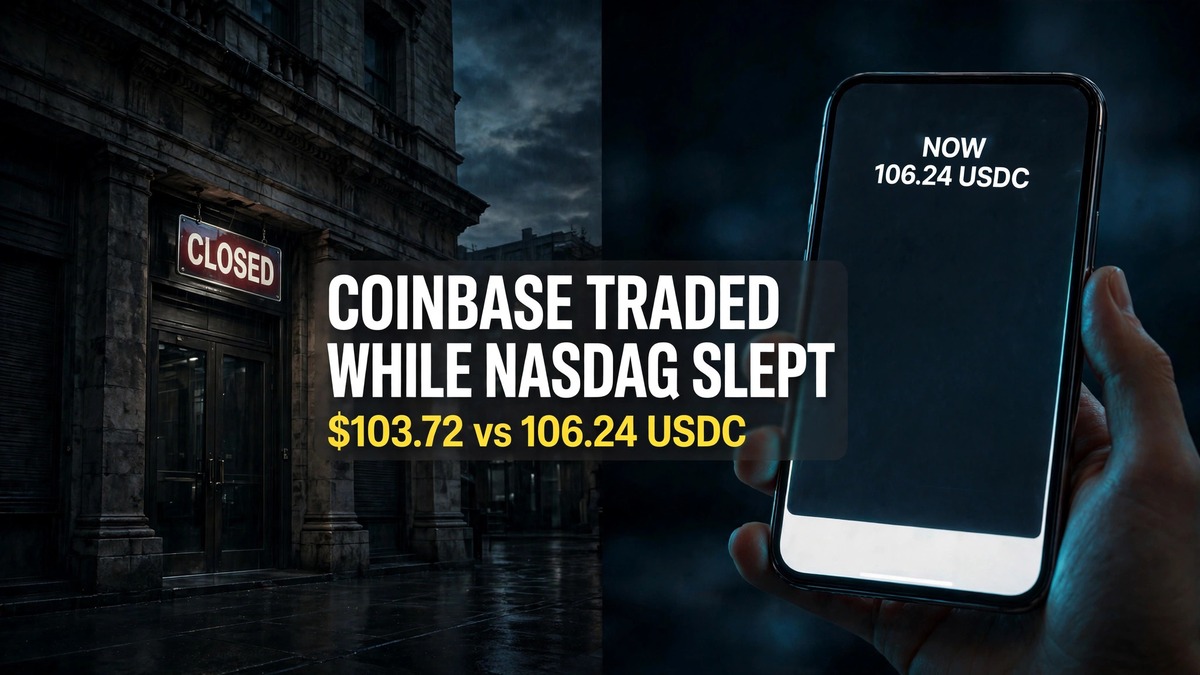
Nasdaq was closed for Thanksgiving. The stock market was dark, the opening bell hours away, and Coinbase shares were supposed to be frozen in place until Friday. Except they were not. On a crypto exchange called OKXICE, tokenized Coinbase shares kept trading through the holiday — and the price they traded at told two completely different stories, depending on which number you compared it to.
That is the strange new reality of tokenized stocks. The shares never sleep anymore, even when the exchange that lists them does. And when the same share can be worth two different things at the same moment, the question stops being what Coinbase is worth — and starts being who gets to decide.
💵 One trade, two stories: 106.24 USDC
The trade itself was tiny. On Thanksgiving afternoon, a buyer on OKXICE spent 125.49 USDC on tokenized Coinbase shares, paying 106.24 USDC per token for just over one token. It was a retail-sized purchase, the kind of trade that would not move a real stock market by a cent. But it was the only live Coinbase price the world had while Nasdaq was closed — and that made it matter far more than its size.
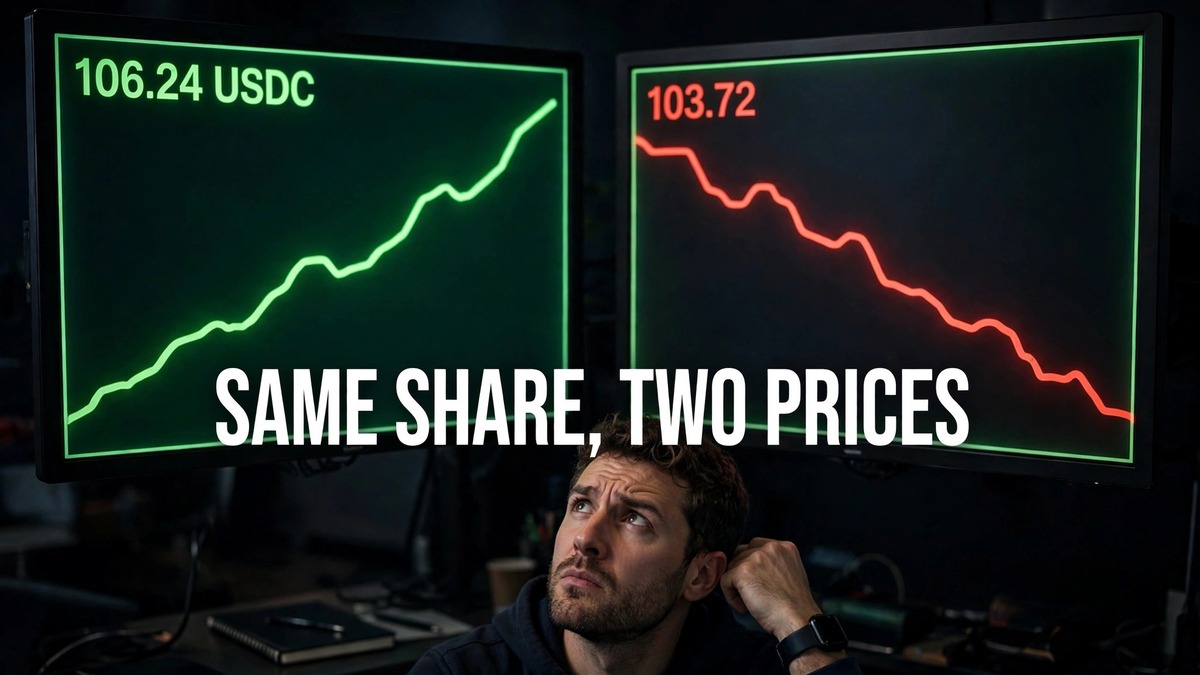
Measured against Wednesday’s Nasdaq closing price of $103.72, the token trade looked like a 2.4% holiday rally. Coinbase up 2.4% while the market was shut? That is a headline. But there was a catch. Coinbase had already traded higher in Wednesday’s after-hours session, reaching $106.91 according to brokerage Public. Measured against that later price, the very same token trade was about 0.6% lower — not a rally at all, but a small discount.
Same trade, same price, same afternoon. A gain if you start from the closing bell, a loss if you start from after-hours. The choice of where to start measuring was enough to turn a gain into a decline — and that is the problem tokenized stocks have just put on full display.
📈 A third price, in Germany, before lunch
It gets stranger. While the OKXICE buyer was paying 106.24 USDC in the afternoon, an investor in Germany had already traded Coinbase shares that morning on Tradegate, at 97.50 euros apiece — roughly $107 at that day’s exchange rate. That was a third price for the same company on the same day, from a market most American investors never think about.
And the day was not over. US overnight stock trading resumed at 8:00 pm on Thursday, and by 5:33 am on Friday, Coinbase shares were at $108.91 in premarket trading. So by Friday morning, the Thanksgiving token trade at 106.24 USDC looked cheap against every benchmark that came after it. The buyer who paid 106.24 USDC on Thursday afternoon had, in hindsight, bought below the Friday premarket price — but nobody could have known that at the time, because there was no single price to compare against.
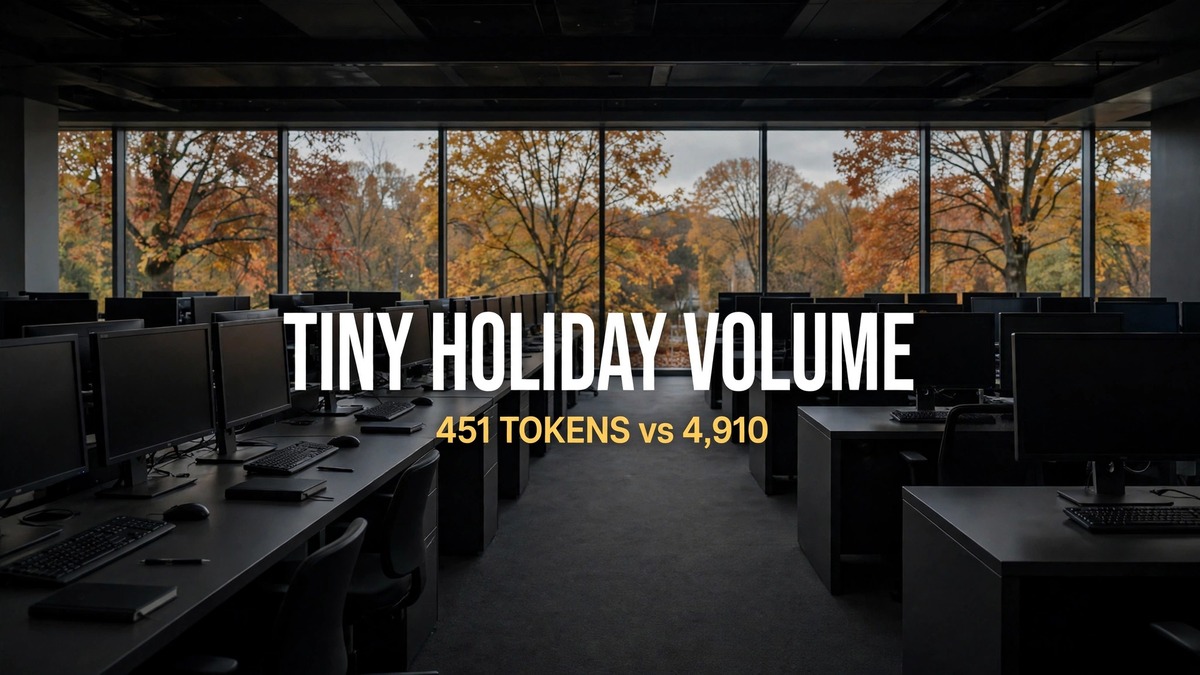
OKXICE only launched its tokenized stock market three days before the holiday, and the volume shows how early this all is: 450.79 tokenized Coinbase shares traded over the entire holiday, down 90.8% from 4,909.96 on Wednesday. The single early-morning Tradegate transaction of 142 shares was nearly a third of OKXICE’s full-day Coinbase volume. These are tiny, thin markets — and thin markets are exactly where prices can look most misleading.
⚠️ The real lesson: there is no single price anymore
Strip away the numbers and the Thanksgiving experiment leaves one big question. When a stock trades on Nasdaq, on Tradegate, in after-hours sessions and as a token on a blockchain — all at different prices, all at different times — which one is the real price?
For a buyer with $10,000 worth of Coinbase to sell, the answer matters enormously. The blockchain could tell you to four decimal places what someone paid for just over one token. But could you get that price for 94 tokens? In a market that traded fewer than 451 tokens all day, the honest answer is probably not. A price for one token is not a price for a real position — and treating it as one is how small investors get hurt.
That is not an argument against tokenized stocks. Trading that never closes, settlement you can watch on a blockchain, and access for people whose markets are shut — those are real advantages, and they are the reason tokenized equities keep growing. But Thanksgiving showed the other side of the coin: when liquidity is thin and venues are fragmented, the price you see can be an artefact of where you looked, not a fact about the company.
🎯 What to watch next
Watch Friday’s verdict first — because it is already in. The regular session opened at $108.53 and closed at $107.04, up 3.2% on the day, with after-hours trading at $107.64. The token buyer who paid 106.24 USDC on Thursday afternoon got a small discount against the real market — the token price was real, but it was the low print of the day, not the market’s verdict. The premarket print of $108.91 at 5:33 am on Friday turned out to be closer to the truth than the token trade was.
Watch the volume second. Tokenized stocks only become a reliable price signal when enough people trade them. A venue doing 451 shares on a holiday is a curiosity. A venue doing real institutional size is a market. Until the volume arrives, every token price should be read with a warning label attached.
And watch the other names. Coinbase was the Thanksgiving test case because it is a crypto-adjacent stock with a crypto-native audience. If tokenized trading spreads to the rest of the market, every holiday, every weekend and every after-hours gap becomes a moment when the same share can wear two prices at once. The future of finance may not wait for the opening bell — but it still has to agree on what things are worth.
Coinbase traded while Nasdaq slept. The price depended entirely on where you looked. That is the promise of tokenized stocks — and the problem they still have to solve.
#CryptoBulletin #Coinbase #COIN #TokenizedStocks #CryptoNews #CryptoMarket #CryptoNewsToday #CryptoMarketToday #TopCryptoStory #OKX #Nasdaq #StockMarket #Thanksgiving #Blockchain #Web3