 Massachusetts Could Ban Every Crypto ATM — Lawmakers Have Until January 5 to Decide
 POTS Money Just Lost $5.71 Million in Minutes — And Its Token Went Straight to Zero
 Strategy Gets Kicked Out of the MSCI Indexes Tomorrow — The $37 Billion Decision Hanging Over Bitcoin
 Binance Just Emptied Its SAFU Bitcoin Wallet — 7,500 BTC Out, $500 Million USDC In
 Cardano’s Big Upgrade Just Slipped to 2027 — And Its DJED Stablecoin Shuts Down on New Year’s Eve
 Dogecoin Price Today, Nov 29: DOGE Stares Down an 8th Straight Losing Week as ETF Flows Stall
 Bitcoin’s Brutal November: Down 24% With 11.1 Million Coins Underwater — Is $59,000 the Floor?
 Tether’s Secret Billionaire Exposed: Russian VC Quietly Holds a Multibillion-Dollar Stake in the $184B Stablecoin Giant

Bitcoin’s wild week has left the market lopsided — and the lopsided side is now the bears. After a volatile stretch that saw Bitcoin slide toward $55,000 and then claw its way back, leveraged bets against the price have piled up to the point where one sharp rally could set off a chain reaction. CryptoQuant CEO Ki Young Ju puts the number at roughly $16 billion in potential short liquidations sitting between $60,000 and $100,000. His verdict, posted on November 26: “Short squeeze fuel is piling up for the next rally.”
A setup is not a guarantee. But when $16 billion of bearish bets are stacked above the price and less than $5 billion of bullish bets sit below it, the market has a clear vulnerability — and traders on both sides know it.
💵 How a short squeeze actually works
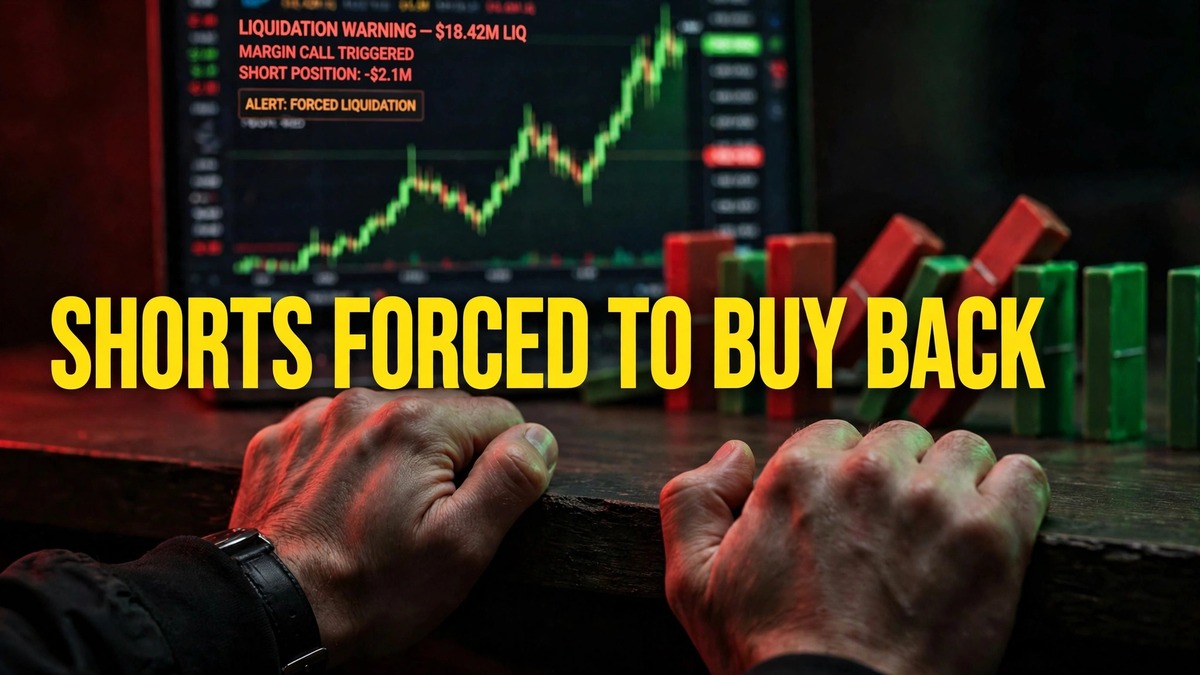
Start with the basics, because the mechanics are what make this dangerous. Shorting means borrowing Bitcoin, selling it, and hoping to buy it back cheaper later. If the price falls, the short seller profits. If the price rises instead, the short seller loses — and if it rises far enough, the exchange liquidates the position automatically, buying Bitcoin back on the trader’s behalf to close the bet.
That forced buying is the fuel. When the price rises and shorts are liquidated, their buy-backs push the price higher. Higher prices liquidate more shorts, whose buy-backs push the price higher still. It is a feedback loop — a chain reaction where each round of forced buying triggers the next one. That is a short squeeze: not a rally driven by new buyers, but a rally driven by sellers being forced to buy.
Leverage is what makes it explosive. A trader shorting with 10x leverage gets liquidated on a move of roughly 10% against them. With 50x or 100x leverage — common in crypto — a move of 1% or 2% is enough. The more leveraged the shorts, the less of a rally it takes to start the cascade. And right now, according to CryptoQuant’s liquidation map, the cascade has about $16 billion of fuel stacked between $60,000 and $100,000, against less than $5 billion of potential long liquidations below that range. That is more than a 3-to-1 imbalance, and it means the squeeze risk is on the short side.
📈 The week that built the trap
The trap was built by Bitcoin’s own volatility. The week began with the slide toward $55,000 — the November 21 low — and the hot PCE inflation print on November 25 that pushed Bitcoin to $57,300 and flipped the Fed’s December meeting toward a hike. Each drop encouraged more traders to bet on further falls. Shorting into weakness looked like the path of least resistance, especially with US spot Bitcoin ETFs recording $5.39 billion in net outflows in November, the weakest month on record.
Then the price turned. Bitcoin reclaimed the $61,400 area and wiped out roughly $47 million in short positions in 24 hours — small against a $16 billion pool, but a preview of how sensitive the positioning has become. Across the wider market, traders betting on a decline lost nearly $170 million to liquidations over 24 hours on Black Friday, with Bitcoin shorts alone losing $64.9 million, according to CoinGlass. More than 72,000 traders were liquidated, and the largest single order was a $9.3 million BTCUSDT short on Binance, closed at $62,147.
The on-chain picture backs up the squeeze case. CryptoQuant analyst Darkfost notes that Bitcoin’s short-term holder MVRV ratio — market value versus realised value for coins held less than 155 days — has fallen to 0.85, approaching the 0.81 reading from the market’s July 1 downturn. Short-term holders are sitting on an average unrealised loss of roughly 15%, with an estimated cost basis near $71,600. Bitcoin would need to rise about 16.5% from recent levels to reach that cost basis — and if it starts moving toward it, the shorts in the way become the fuel.
Bitcoin is trading near $59,743 at the time of writing, down about 2.95% over 24 hours — it briefly reclaimed the $61,400 area intraday on November 27 before slipping back below $60,000. Ethereum is near $1,656.21. The Fear & Greed Index is at 10 — deep in Extreme Fear. Fear is exactly the mood in which crowded short bets feel safest, and that is precisely what makes them fragile.
⚠️ Where the chain reaction would start
Liquidation cascades tend to start at identifiable thresholds, where clusters of stop-losses and liquidation prices sit just above the current market. Based on Bitcoin’s recent position, analysts point to two zones.
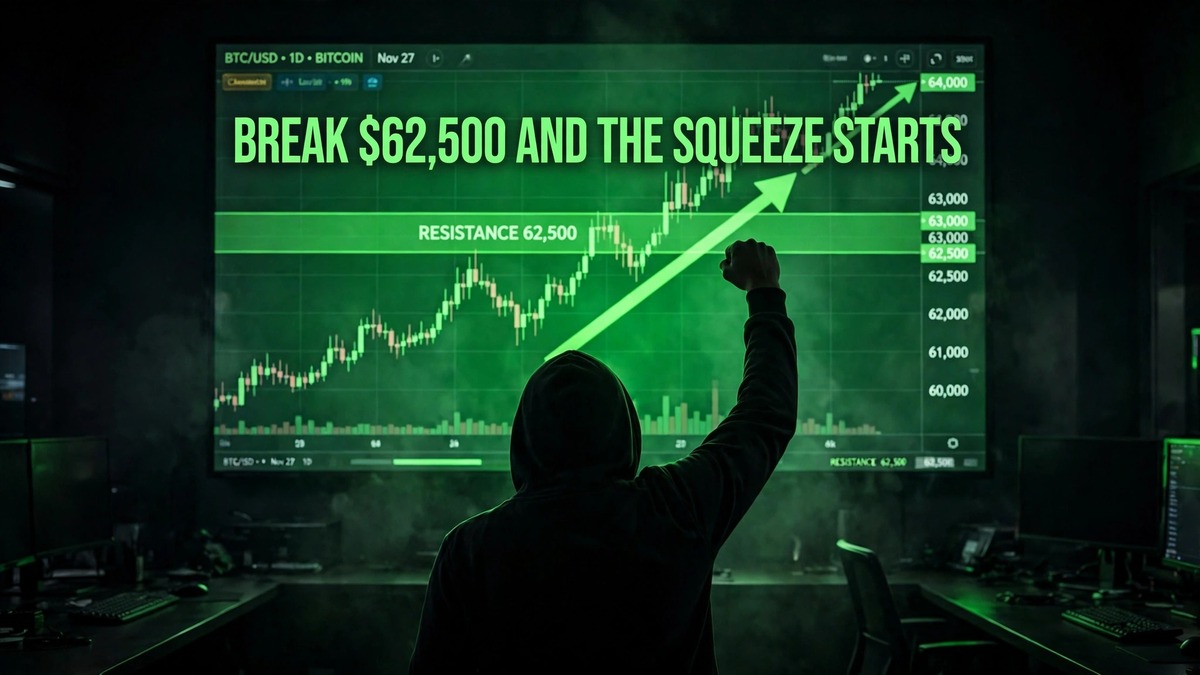
The first is $62,500–$63,000. A decisive close above it would put the most aggressive, highly leveraged shorts under pressure — the ones who shorted nearest the price with the least room to breathe. The second, denser band sits at $64,000–$65,000, where a thicker stack of stop-loss orders is thought to sit. Breaking that could accelerate the forced buying and turn a grind higher into something much faster.
These zones are analytical estimates built on round numbers and recent trading ranges, not exact liquidation data — and they should be read that way. The $16 billion figure itself is a model estimate from CryptoQuant’s liquidation map, which tracks hourly changes in open interest across seven exchanges at $500 price steps. It is designed to identify where liquidation clusters sit, not to forecast the exact amount that will occur or to predict that Bitcoin will reach $100,000.
There is also the other side of the trade. If Bitcoin fails to break higher and rolls over instead, the shorts win, the squeeze never happens, and the $16 billion pool simply sits there — or grows. A setup needs a trigger, and the trigger is a rally with real buying behind it. Open interest has been rising while trading volume fell nearly 47% over a recent 24-hour period, which suggests positioning is building but aggressive buying demand has yet to materialise. The fuel is piled up. Nobody has lit it yet.
🎯 What to watch next
Watch $62,500 first. It is the first trigger zone, and a sustained break above it would start putting the most leveraged shorts under water. Below it, the squeeze is just a theory.
Watch $64,000–$65,000 second. That is the denser band, and breaking it is what would turn a squeeze from a possibility into a cascade. It is also, not coincidentally, the resistance area Bitcoin needs to clear to change the shape of this month.
And watch the volume third. A squeeze driven by forced buying still needs real buyers to start it — and the recent drop in trading volume says they have not arrived in force yet. When volume returns alongside a push through $62,500, that is when the $16 billion starts to matter.
Sixteen billion dollars of shorts are sitting above the price, waiting. All it takes is one strong rally to find out what happens next.
#CryptoBulletin #Bitcoin #BTC #BTCPrice #BitcoinPrice #ShortSqueeze #CryptoQuant #CryptoNews #CryptoMarket #CryptoNewsToday #CryptoMarketToday #TopCryptoStory #CryptoTrading #Ethereum #Altcoins