 Lil Pudgys Floor Holds Near 0.22 ETH as the Little Penguins Weather a Red Day
 Jensen Huang Is Back at Nvidia — and the Memecoin Market Lost Its Mind Overnight
 Saturn’s sUSDat Pays 11%+ — The Stablecoin Vault With a 3–7 Day Catch
 Kraken’s kBTC Vault Pulled In $30 Million on Day One — Bitcoin Yield Is Having a Moment
 Maple’s syrupUSDG Just Passed $200 Million — Its First New Syrup Asset in Two Years
 Ondo Just Tokenized Silver and Gold — SLVon and IAUon Bring Wall Street Metals Onchain
 Your Next House Deed Might Be an NFT — Real Estate Tokens Are Quietly Moving
 Pupkins: The NFT Game Where Your Pet Holds Real Stocks — and Everyone Is Talking About It
By every rule of crypto, Ethena’s USDe should be dead by now. It has lost two-thirds of its supply, had its token subsidies switched off, watched its yield compress from double digits to single digits, and survived the worst crash in the market’s history. And yet there it is — still holding its dollar peg, still paying a yield, still standing.
USDe is the synthetic dollar that refuses to die. The question is not whether it survived. It is what survival looks like when the easy money is gone.
💵 From $15 billion to $4.9 billion — the great shrinking
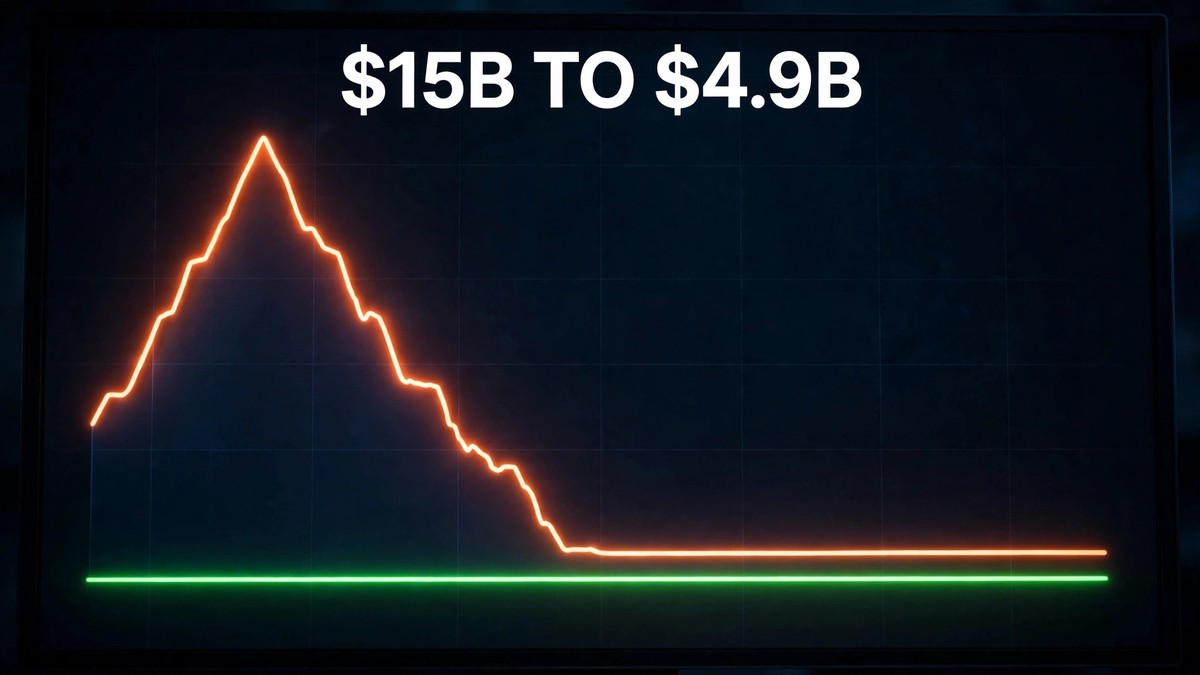
The numbers tell the story in one line. At its peak in October 2025, roughly $15 billion of USDe was in circulation. Today, supply sits at about $4.9 billion, according to DeFiLlama data updated on November 24, 2026 — a fall of more than two-thirds in a year. The token that was once the fastest-growing dollar in crypto is now a third of its former size.
The shrink has a clear cause. Ethena ended the ENA token incentives around USDe on September 30, 2026, announcing on September 26 that incentives had already fallen roughly 85% since the first airdrop in 2024 and that from October there would be no token incentives at all. The subsidy worked while it ran — it bought growth at a spectacular rate — and its wind-down can be read directly off the size of the token. From October, all that is left on USDe is what the protocol actually earns in the market.
That is a brutal transition, and most subsidised products do not survive it. USDe did — smaller, quieter, and still functioning. Around $1.8 billion of it is supplied to lending markets across 12 protocols, more than a third of its entire supply, which is an unusually high share for any stablecoin and a sign that DeFi still finds it useful.
📈 The yield is still there — just smaller and honest
Staked USDe, or sUSDe, still pays. The current rate is around 4.75% APY according to rate trackers updated on November 24, 2026, with some feeds showing about 4.93% — a long way from the double-digit yields of the bull market, when sUSDe averaged about 10.9% since January 2024, but a real return in a market where most dollars pay nothing.
The yield comes from the same machine it always did. USDe is backed by crypto collateral — Bitcoin, Ethereum and liquid staking tokens — hedged with short perpetual futures, so the price exposure is stripped out. The return comes from funding rates, the payments that flow between longs and shorts on perpetual futures, plus the staking income on the collateral. When funding rates are weak, Ethena moves a share of the backing into liquid stablecoins such as its reserve-backed USDtb. When markets are hot and longs are crowded, the yield rises. When they are not, it falls — and it can fall to zero.
That is the honest version of the product: a yield that follows derivatives markets rather than borrowing demand, with no token subsidy smoothing the edges any more. The 4.75% on offer today is what the market is actually paying, not what a marketing budget is topping up.
⚠️ The crash it survived — and the risks that remain
USDe’s claim to toughness rests on one day: October 10, 2025, when Bitcoin plunged and the largest liquidation event in crypto history tore through the market. USDe traded as low as about $0.65 on Binance that day — but that was Binance’s own thin order book pricing it, and elsewhere it stayed within about 0.3% of a dollar. Around $2 billion was redeemed in 24 hours without minting or redemption stopping. The peg bent where the market was thinnest, and held where it mattered.
The risks have not gone away. USDe depends on positive funding rates, and funding can turn negative when markets fall. It depends on the exchanges and custodians holding its hedges, and on the Reserve Fund absorbing periods of negative revenue — that fund stood at $61 million in March 2026, small next to a $4.9 billion supply. And sUSDe carries a 7-day unstaking period, so holders cannot exit instantly when conditions turn.
There is also the regulatory shadow. Ethena’s German entity was wound up by BaFin back in 2025, and USDe is not authorised as an e-money token under the EU’s MiCA rules. The synthetic dollar lives in a grey zone that traditional stablecoins have been working to leave.

🎯 What to watch next
Watch the supply line first. If USDe stabilises around $5 billion and holds there without subsidies, the product has found its honest size — a working synthetic dollar that earns what it earns. If the shrink continues into 2027, the market is saying the post-subsidy yield is not enough. Watch funding rates second: they are the yield, and a long stretch of negative funding is the one thing that would truly test the peg.
USDe lost its subsidies, lost two-thirds of its supply, and lost the bull market that made it famous. It kept its peg. In this market, that counts as refusing to die.
#CryptoBulletin #DeFi #Ethena #USDe #sUSDe #SyntheticDollar #Stablecoins #CryptoNews #CryptoNewsToday #TopCryptoStory #Blockchain #YieldFarming #Web3 #CryptoMarket #ENA